ScrollPowerful knowledge agents
- Role: Sr Software Engineer
- Tenure: Sept 2024 – June 2026




- React
- Typescript
- Next.js
- Zero Sync
- ProseMirror
- tRPC
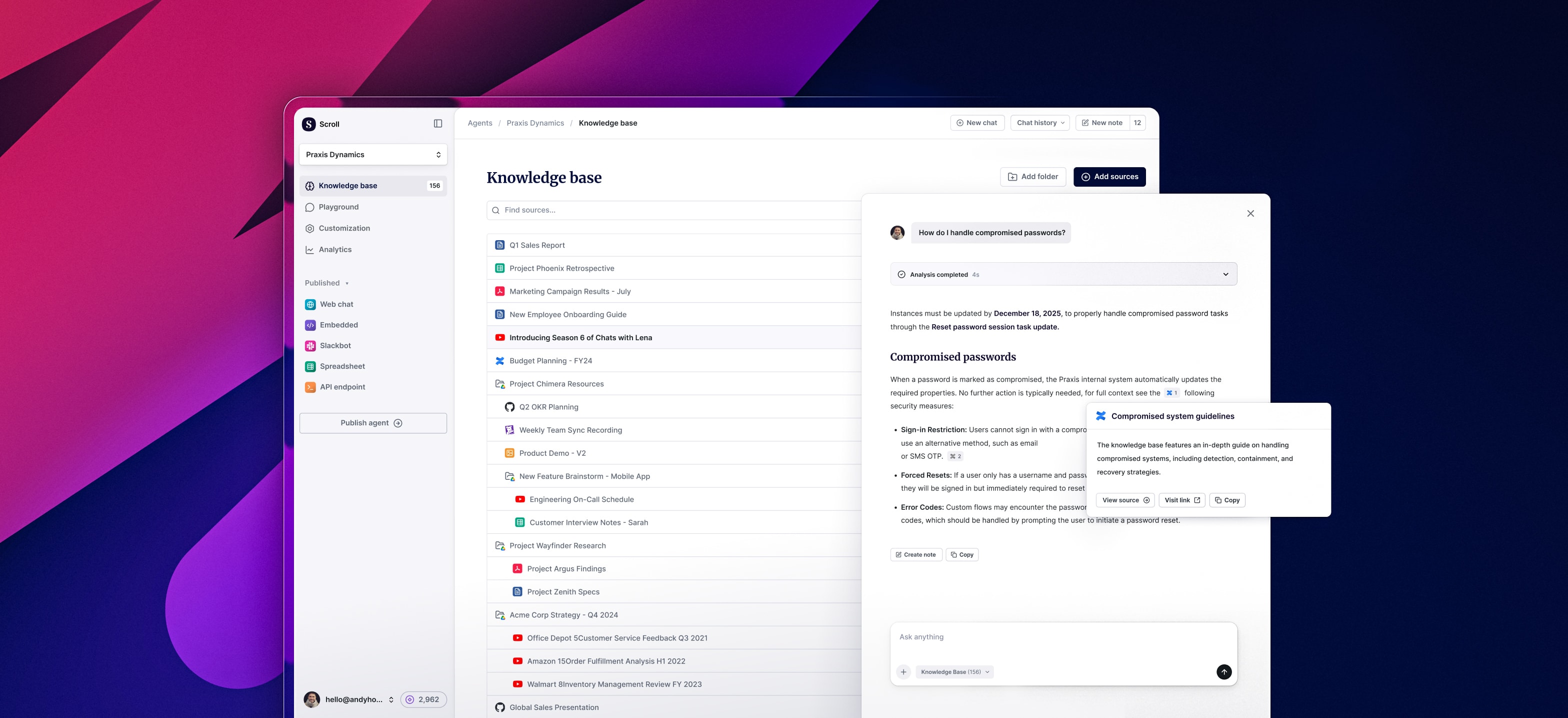
Scroll transforms your company’s knowledge into powerful domain experts. Connect your organizational documents, spreadsheets, videos, and internal resources and deploy powerful knowledge agents across your product surfaces. Scroll delivers instant, reliable answers and streamlines workflows.
Overview
I joined Scroll in 2024, when the team was focused on building a research tool tailored for journalists. The company later pivoted toward intelligent domain agents, leveraging AI-enhanced source ingestion pipelines and rich-text editing technology to deliver streamed conversations and highly accurate responses.
I worked across nearly every user surface of the product, including rich-text editing, sharing, permissions, authentication, entitlements, browser extensions, spreadsheet autofill interfaces, billing and more.
Although my primary focus was crafting an intuitive front-end, I also contributed across the stack. My work included implementing both client and server-side image cropping, advanced drag-and-drop organization, nested file and folder management, interactive chat suggestion and citation rendering, and an intuitive source sync interface.
Optimistic UI as a baseline experience
Optimistic UI was a core pillar of the product design, and the earliest iterations of Scroll used the tRPC integration of React Query. While this approach worked well at first, the complexity of managing optimistic cache updates in memory quickly grew beyond its limits as the product expanded. It became increasingly difficult to reason about all the data dependencies involved in a single user interaction.
We later adopted Zero from Rocicorp, which proved to be a excellent tool. As a sync engine, its architecture is built around a “client-first” model where optimistic changes are applied locally via IndexedDB, with automatic handling of rollbacks and reconciliation. Because it integrates natively with PostgreSQL, changes made at the database level are seamlessly propagated back to all connected clients.
This enabled us to deliver highly responsive, fluid-feeling features with immediate feedback. Drag-and-drop nesting of files and folders is a particularly strong example: the UI is derived directly from a live query, with instant feedback and no intermediate or inconsistent states.
AI-native, embracing new technology
Scroll embraced AI at the core of the company. As a small team, we needed to leverage every possible efficiency gain, and we made extensive use of LLM agents for ticket creation, security and severity reviews, bug triage, knowledge transfer, and as part of our integrated development environments.
The progress over just two years has been significant. Each week brought improvements in reliability and accuracy, and I’ve never felt more empowered or confident in my ability to learn new technologies. These tools also enabled me to work in parts of the codebase I would previously have avoided.
While we still have a long way to go in adapting to this non-deterministic paradigm, LLMs as a learning tool alone are already transformative. With code generation improving week by week, we’re entering an era where we can focus on solving increasingly larger problems, and working with the Scroll team taught me a great deal about the future possibilities.
“Andy is self-reliant, smart, and technically very strong. He doesn't just build what is asked, but thinks through what users are trying to do, where the product might feel confusing, and how to make the final experience simpler, clearer, and more useful.”

- Name
- Elik Eizenberg
- Role
- CEO & Founder
- Company
- Scroll AI